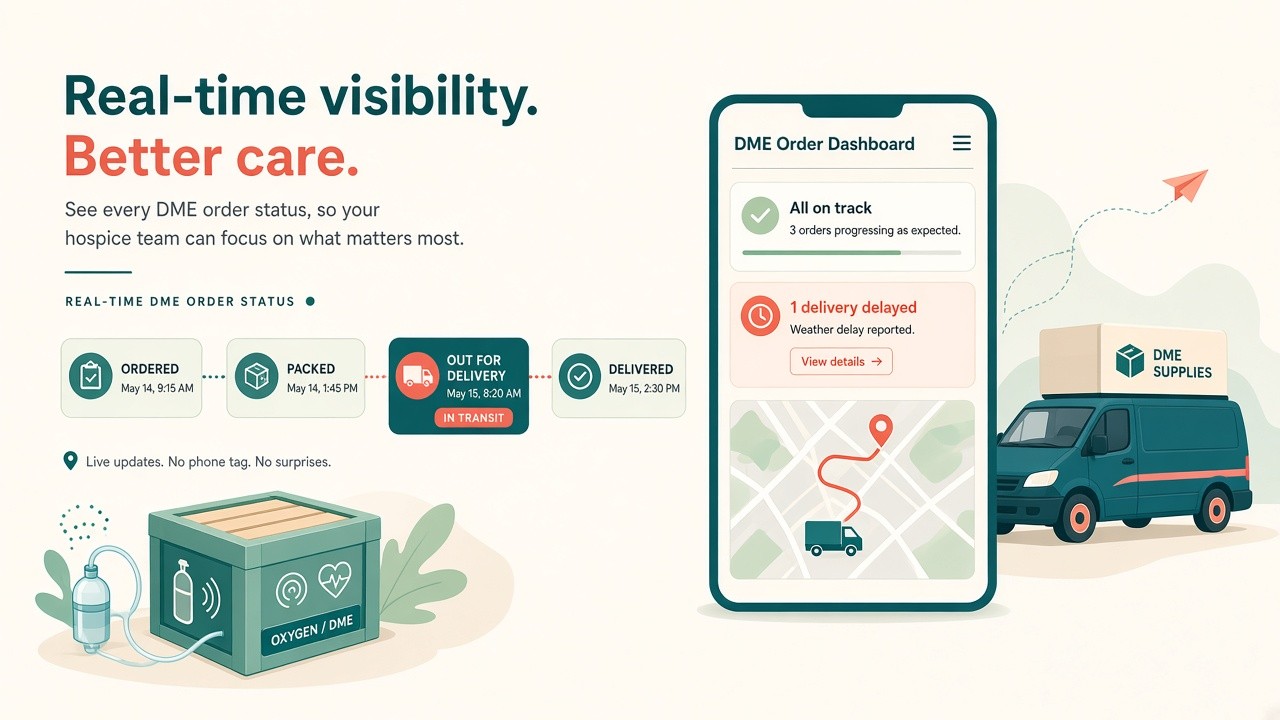
Ask hospice intake and clinical coordinators what frustrates them about DME, and the answer is rarely "we need more product SKUs on the portal."
It is: where is the order?
Bed not delivered. Oxygen delayed. A weekend delivery that nobody can confirm. A family calling the hospice because the equipment did not show, and the hospice calling the DME vendor because their own system still says "submitted."
Feature lists do not fix that. Status visibility does.
Referral partners lose track of deliveries for boring reasons
Hospice agencies are not trying to micromanage your warehouse. They are trying to keep a patient safe at home and keep the family from calling every hour.
Typical friction looks like this:
- Order placed, acknowledgment vague or delayed
- Delivery window changes without a push update to the agency
- Driver en route, but the hospice still sees "open"
- Partial delivery (some items yes, some no) with no clear status split
- Proof of delivery exists somewhere, but not where the nurse can see it when the family asks
Each of those is a phone call. Phone calls do not scale across a census of active DME orders.
When Miles surveyed hospice partners about what they valued from a DME vendor relationship, real-time updates on orders ranked at the top. Not a longer catalog. Not a prettier brochure. Real-time order status.
That matches how hospice operations actually run: nurses and coordinators need current truth, not a ticket number and a promise to call back.
Status visibility beats feature lists
DME vendors often compete on inventory breadth, pricing, or specialty equipment. Those matter. They are not what keeps a hospice from switching after a bad weekend.
What keeps the relationship healthy is whether the agency can answer, without calling you:
- Was the order received?
- Is it scheduled?
- Is it out for delivery?
- Was it completed, refused, or partial?
- Who signed, and when?
If the hospice can see that loop close in near real time, your brand feels reliable even when a delivery is late. Late with visibility is recoverable. Late with silence becomes a vendor problem.
Driver apps and proof of delivery matter here as supporting pieces, not as the headline. POD is evidence after the fact. The agency’s daily need is live status while the order is still in motion.
What “real-time” has to mean in practice
Real-time does not mean a marketing dashboard with vanity metrics. It means operational updates the hospice can act on.
A useful order status loop usually includes:
- Order received / accepted (or rejected with a reason)
- Scheduled with date/window when known
- Out for delivery
- Delivered, partial, refused, or cancelled
- Notes the agency can see without opening a separate email thread
The channel can be a portal, a feed into the hospice’s workflow, or both. The requirement is the same: the person fielding the family call should not have to invent an answer.
How DME Engine closes that loop
DME Engine is built around order lifecycle visibility for DME operations that serve hospice and similar referral partners. Soft product mention, not a feature dump: order updates are the point. Driver app and POD support the same loop by giving field status somewhere to land, so the agency is not waiting on a callback while the truck is already on the street.
If you run a DME company selling into hospice, the question to pressure-test is simple: can a hospice coordinator see order status without calling your office?
If the answer is no, the rest of your feature list is secondary.
A short sales conversation that respects operators
When you talk to a hospice about DME partnership, lead with status, then prove the rest:
- Show how an order moves from submit to delivered on one timeline
- Show what the agency sees when a window slips
- Show how partials and refusals are represented
- Only then walk inventory, specialties, and pricing
That order of conversation matches what hospices say they want. It also filters serious buyers from brochure collectors.
For a quick walkthrough, Miles takes short demos at https://calendly.com/miles-pickens/15min. Product overview lives at https://dmeengine.org. If phone is easier: 866-522-1138 x3.
See DME Engine or book a short demo
dmeengine.org · Calendly (15 min) · Phone: 866-522-1138 x3
Bottom line
Hospice agencies want real-time order status from their DME vendor because deliveries are clinical risk and family communication, not just logistics. Status visibility beats feature lists. Close the loop with live order updates; treat driver app and POD as support for that loop, not as the substitute for it.
See DME Engine or book a short demo: https://dmeengine.org · https://calendly.com/miles-pickens/15min